
Major new Harlem Renaissance exhibition opens Sept. 13

By Molly Minturn |


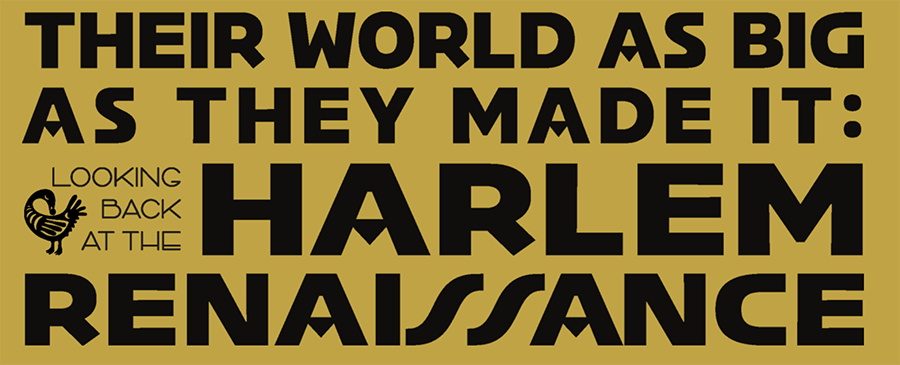
“Their World As Big As They Made It: Looking Back at the Harlem Renaissance” banner

Guest post by Holly Robertson, Curator of University Library Exhibitions

One hundred years ago, the artistic and political revolutions of the Harlem Renaissance were in full swing. The unmistakable sounds, images, words, and conventions of the era indelibly shaped American culture.

On Wednesday, Sept. 13, the University of Virginia Library will open its major new exhibition: “Their World As Big As They Made It: Looking Back at the Harlem Renaissance” in the Main Gallery of the Harrison Institute and Small Special Collections Library. 

Featuring the visionary works of writers, artists, and thinkers of the Harlem Renaissance, this exhibition examines the creative and intellectual pursuits that defined Black American identity and political consciousness. The Albert and Shirley Small Special Collections Library is fortunate to hold a wide selection of influential books, magazines, illustrations, and manuscripts by these Harlem Renaissance creators. 

We’ll celebrate this retrospective throughout the building with an open-house style event starting at 5:30 p.m. that will feature live music from the Charlottesville Jazz Congregation, great food, and gallery talks. Art in conversation with Harlem Renaissance poetry — part of our Arts Council grant project “As Big As We Make It!” — will be on display in the Main Gallery. 

This event is free and open to the public. No tickets are required but register to let us know you’re coming, to stay updated on event details, and especially if you’d like free parking in the Central Grounds Garage. 

 Exhibition Opening

  • “Their World As Big As They Made It: Looking Back at the Harlem Renaissance”
  • Wednesday, September 13 — 5:30 to 7:30 p.m.
  • Harrison/Small — 170 McCormick Road 
  • Register for more details and free parking

Take a look at some preview photos of the exhibition below. All photography by Stacey Evans.

Main studio gallery space featuring works by James Weldon Johnson and W.E.B. Du Bois.
“Their World As Big As They Made It: Looking Back at the Harlem Renaissance” features works by writer and civil rights activist James Weldon Johnson and W.E.B. Du Bois, one of the founders of the NAACP and author of “The Souls of Black Folk.”
Main gallery exhibition space featuring works by Claude McKay and Langston Hughes
Here, the exhibition focuses on works by Jamaican American poet Claude McKay and American writer Langston Hughes, perhaps best known for his 1920 poem, “The Negro Speaks of Rivers.”
Main gallery exhibition space featuring the music of James Weldon and J. Rosamond Johnson
This corner of the exhibition examines the music of brothers James Weldon Johnson and J. Rosamond Johnson, who together composed the hymn “Lift Every Voice and Sing.”


You might also like...

A year of AI literacy, unearthed archives, and community moments

Stylized photos of UVA places with the text: 2026 Annual Report
To answer that question, this year’s annual report has 25 stories that run the gamut — from tech-driven digital scholarship and artificial intelligence to community zines and children’s photography.


Spooky season continues: New exhibition explores Edgar Allan Poe’s student life

A woman smiles alongside two busts of Edgar Allan Poe, a thumbnail of an exhibition poster, and a hand-signed note
A new exhibition explores Edgar Allan Poe’s time as a rambunctious UVA student before he became a well-known writer.


Memento mori: A skull fragment in Special Collections is the focus of a new article in the Journal of the American Revolution

Left side: Individual setting up a video camera on tripod in a building with large columns overlooking a park. Right side: Two items inside a display case. One is a box labeled 'Skull Fragment of David Steele from Battle of Guilford Courthouse MSS 106 16c.' The other is a labeled plastic bag containing a piece of skull bone.
Heritage professional Emelia Lehmann wrote about a most unusual and somewhat gruesome artifact that caught her attention when she worked in the Albert and Shirley Small Special Collections Library as a graduate student.


Subscribe to get UVA Library News in your inbox

Browse by category