
This year’s LGBTQ+ Pride Month blog post contains a wide variety of recommendations from UVA Library staff Keith Weimer, Librarian for History and Religious Studies; Laura Hjerpe, Senior Research Data Management Librarian; Becca Velasquez, Circulation Support Coordinator; and Cecelia Parks, Undergraduate Student Success Librarian, from literary fiction to biography to recent works of queer American history.
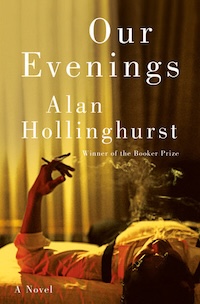 “Our Evenings” by Alan Hollinghurst (Random House, 2024)
“Our Evenings” by Alan Hollinghurst is the fictional memoir of David Win, a 68-year-old gay British actor, reviewing his life from the time of Brexit to his adolescence in the early 1960s. The son of a deceased(?) Burmese father and an English mother, David is a recipient of prejudice as well as privilege thanks to the generosity of Mark and Cara Hadlow, wealthy liberals who endow scholarships enabling boys like him to attend elite public schools and eventually Oxford. Mark and Cara function as surrogate parents to David, though he has a close relationship with his mother and with her partner Esme. Perhaps as a result, this is an understated novel, in which even the most shocking episode (perhaps not surprisingly, set in the spring of 1970) is sandwiched between quiet emotional wrestling and a great deal of earnest small talk that may be a way of deflecting pain. Coming of age as Britain decriminalizes homosexual acts in the late 1960s, David presents neither shame nor intense pride as he pursues meaningful relationships and navigates his layered identity, though the title, an allusion to the maxim “our evenings are not our own,” leaves one to question how much of David’s life has truly been his own.
— Contributed by Keith Weimer
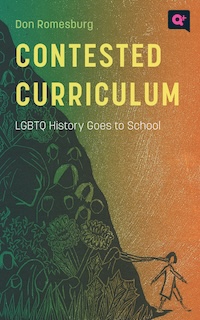 “Contested Curriculum: LGBTQ History Goes to School” by Don Romesburg (Rutgers University Press, 2025)
In the context of legislative and cultural attacks on the rights of LGBTQ+ young people, leading to interventions like Florida’s “Don’t Say Gay” law, “Contested Curriculum” uses Romesburg’s work in California to pass the FAIR Education Act that mandated inclusion of LGBTQ+ history in the California K-12 history curriculum to explore the broader context of LGBTQ+ history education in the United States. Romesburg explores the “history wars ... the culture wars over history education” that have occurred over the last 50 years, detailing the conflict between presenting a “heritage” or a “historical” model of the past in K-12 classrooms: the heritage model focuses on history as a tool for instilling patriotism and creating a unified national identity, while the historical model focuses on critical thinking skills and connections with the present. The question of whether and how to teach LGBTQ+ history in public K-12 classrooms has been a key battleground in the debate over the heritage vs. historical models of teaching history, which continue today.
— Contributed by Cecelia Parks
 “Confederate Sympathies: Same-sex Romance, Disunion, and Reunion in the Civil War Era” by Andrew Donnelly (The University of North Carolina Press, 2025)
Much has been written about the Civil War in popular and academic histories, but Donnelly’s “Confederate Sympathies” explores a new angle of the conflict by examining the use of same-sex attraction and intimacy between men as a rhetorical strategy to bridge the divide between North and South. Donnelly argues that “the meaning of the Civil War has shaped and been shaped by male same-sex romance and the history of homosexuality,” from encouraging compromises that allowed slavery to expand through the nostalgic postwar portrayal of wholesome antebellum homoeroticism that was used to further the Lost Cause project and hinder Reconstruction. Though homosexuality or queer identity as we understand it today did not exist in the period Donnelly considers, he argues that there was still a powerful cultural and literary tradition of same-sex attraction that shaped Civil War-era politics.
— Contributed by Cecelia Parks
 “A History of Transgender Medicine in the United States: From Margins to Mainstream” edited by Carolyn Wolf-Gould, Dallas Denny, Jamison Green, and Kyan Lynch (SUNY Press, 2025)
Comprised of essays from more than 40 authors and researchers, “A History of Transgender Medicine in the United States” attempts to “present a uniquely trans-focused interpretation of the history of transgender healthcare.” The book begins by acknowledging the presence and knowledge of trans and gender-diverse individuals in America before the arrival of European colonizers and the origins of what we know today as gender-affirming medical care in Germany. Then, narrowing the focus to the United States, the authors explore the arrival of gender-affirming care in the US and the struggle of trans and gender-diverse people to make care — not just specifically transition-related care, but all gender-affirming care — available in mainstream healthcare settings. The authors note that at times, this struggle has looked more like a fight for liberation than an evolution of a medical field. That providing and receiving gender-affirming care is a fight has never been clearer today, when such care is under attack across the United States, and this book provides valuable context for understanding that fight and its stakes.
— Contributed by Cecelia Parks
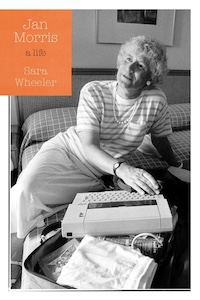 “Jan Morris: A Life” by Sara Wheeler (HarperCollins, 2026)
A successful British foreign correspondent and travel writer, Jan Morris transitioned to living as a woman in the early 1970s. She was one of the first to publicly write about this experience in her autobiography, “Conundrum,” a lifeline to many transgender people. Sara Wheeler presents a fascinating portrait of Morris, though aspects of her character remain a mystery. She also covers a good sample of Morris’ writing —news, travel, history, memoir, and even science fiction – with anecdotes from newspapers, publishers, and fellow writers. For “Conundrum,” she goes into detail about the editing, criticism, public reception, and legacy. This biography is written in memory of Elizabeth, Morris’ wife and then partner, who passed in 2024. She and Morris had five children together, four of whom survived, and they maintained a strong bond until Morris’ death in 2020. I decided to read Wheeler’s biography because of her appreciation for Morris’ writing, and I had read “Trieste and the Meaning of Nowhere” and “Conundrum.” After reading this book, I found myself impressed by Wheeler’s balanced criticism of Morris’ considerable literary output.
— Contributed by Laura Hjerpe
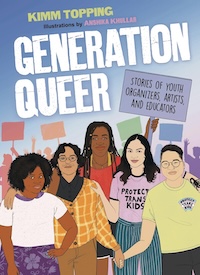 “Generation Queer: Stories of Youth Organizers, Artists, and Educators” by Kimm Topping , illustrated by Anshika Khullar (Tu Books, 2025)
Immerse yourself in a vibrant and unapologetic celebration of queer joy, creativity, and authenticity. This powerful collection celebrates activists, artists, educators, and organizers who are courageously reshaping the future, while highlighting how readers can advocate for the queer community. “Generation Queer” is packed with inspiring stories, brave voices, and bold artwork, of young LGBTQ+ people around the world.
— Contributed by Becca Velasquez
 “How We Named the Stars” by Andrés N. Ordorica (Tin House, 2024)
“How We Named the Stars” centers on Daniel, a first-generation college student on scholarship at an elite university, already burdened by intense academic pressure and the weight of his immigrant parents’ expectations. His life has long been shaped by the shadow of his own name, given in memory of his uncle whose sudden, traumatic death left a grief his family has never fully healed from. For the first time, distance from home gives Daniel the space to breathe, and to confront something he has quietly been hiding from: he is gay.
— Contributed by Becca Velasquez


