
Patrick Oliphant, a giant of 20th-century political cartooning, has died in Santa Fe, New Mexico. He was 90 years old.
Oliphant, who died on July 13, built his reputation over a half century in which he emigrated from Australia and developed a distinctive signature style to become one of America’s most renowned and influential political cartoonists. He described his creative process as fueled by anger — “I bring myself to a boil every day,” he said — and he was an equal opportunity offender, skewering political figures across the ideological spectrum.
Oliphant first came to prominence in the 1960s, winning the Pulitzer Prize for Editorial Cartooning in 1967 for a Vietnam-era cartoon depicting Ho Chi Minh carrying a dead Viet Cong soldier in the pose of Michelangelo's Pieta. Although Oliphant himself criticized the Pulitzer Board for choosing his cartoon for its subject matter rather than the quality of the art, and never again submitted his work for a Pulitzer, he went on to win numerous awards and honors. These included the National Cartoonist Society Editorial Cartoon Award (seven times between 1971 and 1991), the Reuben Award for Outstanding Cartoonist of the Year in 1968 and 1972, and the Thomas Nast Prize for Editorial Cartooning in 1992.

In 2018, Oliphant donated his archive — thousands of items including drawings, watercolors, prints, sculptures, sketchbooks, correspondence, photographs, and more — to the University of Virginia Library, where it is housed in the Albert and Shirley Small Special Collections Library. The gift includes the printing plate used by the Denver Post for his Pulitzer Prize-winning cartoon, scrapbooks assembled by his father that document Oliphant’s early career in Australia, and more than 6,000 of his daily political cartoon drawings. Then-University Librarian and Dean of Libraries John Unsworth noted Oliphant's significance and the research potential of the collection for scholars at the University and beyond. “Pat Oliphant decided to leave his life’s work to UVA because of our many connections to the presidency in the United States, and I hope that future scholars of that institution will come to Special Collections to study Patrick’s sustained and satirical critique of power in 20th-century America,” said Unsworth. “No one could see through an emperor’s new clothes like he could, and I was proud to call him my friend.” Current Library Dean Leo Lo reiterated the importance of the collection. “Patrick Oliphant's gift to the University and to scholarship is monumental. It is record of the wit, insight, and searing immediacy of the work that defined his career. But it also offers scholars a deep look into the archive of a working artist. We look forward to all that researchers will glean from the Oliphant archive, and we remain grateful for his foresight in donating this amazing collection.”

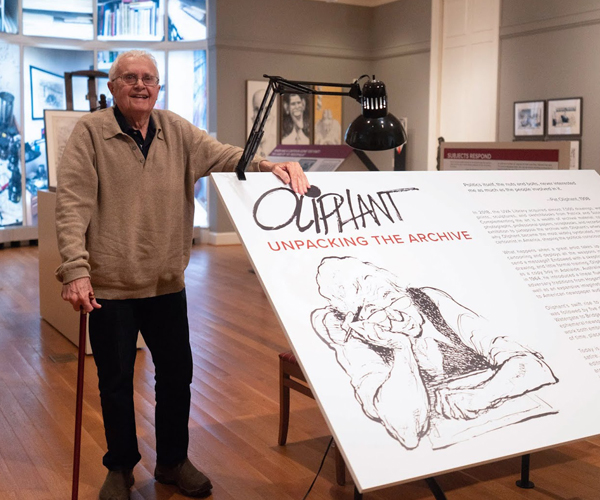
The archive was the subject of a major 2019 exhibition in the Small Special Collections Library, “Oliphant: Unpacking the Archive.” Curated by Library Curator Molly Schwartzburg and University Professor of Art History Elizabeth Hutton Turner, the show paired Oliphant’s newspaper cartoons with his fine-art sculpture and watercolors, as well as items such as his sketchbooks and scrapbooks. The gallery also displayed one of Oliphant’s actual drawing boards, on loan from the artist, alongside recreated photographs of his home studio. Turner, now University Professor Emerita and former Vice Provost for the Arts, was friends with Oliphant and his wife, Susan Conway Oliphant, and was instrumental in bringing the archive to the University. She noted that the Oliphants saw UVA as a natural place for the body of work to reside. “In placing the Oliphant drawings and archive at UVA, the Oliphants wanted to match strength to strength,” said Turner. “We at UVA wanted to make clear how their collection would be magnified, in a way multiplied, by the holdings of UVA’s Special Collections in American literature, history, and material/visual culture as well as by the scholarly studies, expertise and very public dialogue surrounding the American presidency, democracy, and politics.”

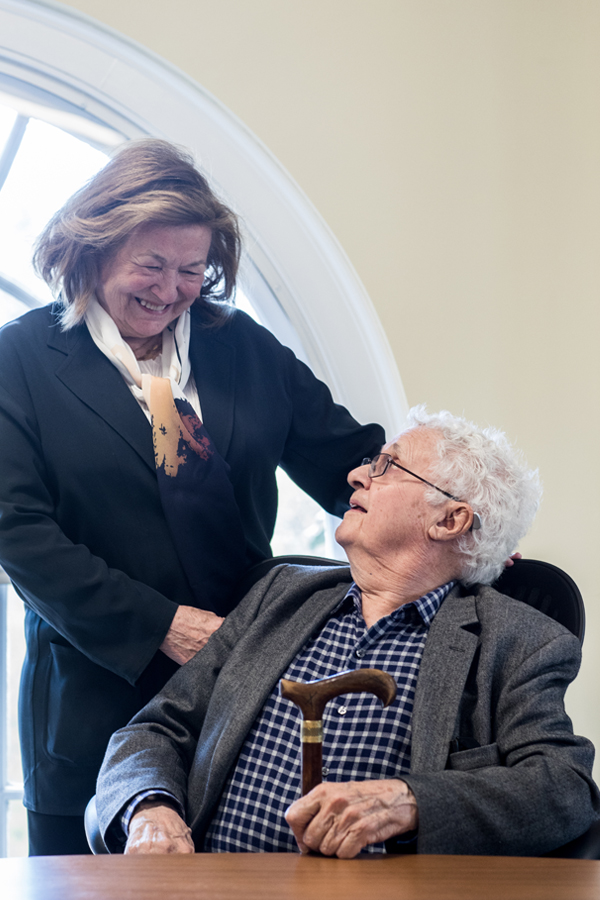
The exhibition drew thousands of visitors, including the Oliphants, who traveled from Santa Fe for the opening and associated events, including a celebratory dinner, panels hosted by the Miller Center and School of Law, and a reception and screening of a work-in-progress documentary by filmmaker Bill Banowsky. Conway Oliphant, a conservator and gallery owner who predeceased her husband in December 2025, had meticulously archived, organized, and maintained the collection for decades, and the Oliphants worked closely with University and Library staff as the exhibition was conceived and planned. Patrick Oliphant called the result “beautifully done,” adding, “I can’t think of a time when I’ve seen my work better displayed.”
The archive generated attention beyond the initial exhibition. The acquisition was the motivation for 2020’s “The Future of American Political Cartoons: A Symposium in Honor of Pat Oliphant,” which brought together some of the most prominent political cartoonists in the country in conversation about the genre. Banowsky’s work-in-progress became the 2025 documentary “A Savage Art: The Life & Cartoons of Pat Oliphant,” shown at the Virginia Film Festival. Banowsky noted that the film could not have been made without the support of the Small Special Collections Library, which made the archive available to filmmakers. And the collection continues to serve as a resource for scholars in fields ranging from art history and politics to rhetoric and media studies.
Brenda Gunn, Associate University Librarian for Special Collections and Preservation, summed up the importance of Oliphant’s work and the archive’s significance: “Patrick Oliphant had an extraordinary gift which allowed him to distill the most complicated political, social, and cultural moments of the late 20th century into a single image, often without a word. Preserving his archive means future researchers can study Oliphant’s body of work and offer new insights into the American experience. Those contributions to scholarship and our collective understanding of national and international events will be the truest measure of his legacy.”


